


Solubility Introduction of PGMA (Poly(glycidyl methacrylate), Mw 40000–80000
- 2026-07-15
- 168
- Weicheng Advanced Material (Shandong) Co., Ltd.
AI-assisted content. please verify.
Solubility Introduction of PGMA (Poly(glycidyl methacrylate), Mw 40000–80000
Solubility
Soluble in THF, acetone, MEK, ethyl acetate, DMF, dichloromethane;
Swell slightly in toluene, xylene, butanol;
Insoluble in water, ethanol, methanol, aliphatic hydrocarbons and mineral oil.Dissolution rate can be improved by mild heating (≤60°C). Crosslinked PGMA is insoluble in all organic solvents.
1. Core solubility rule
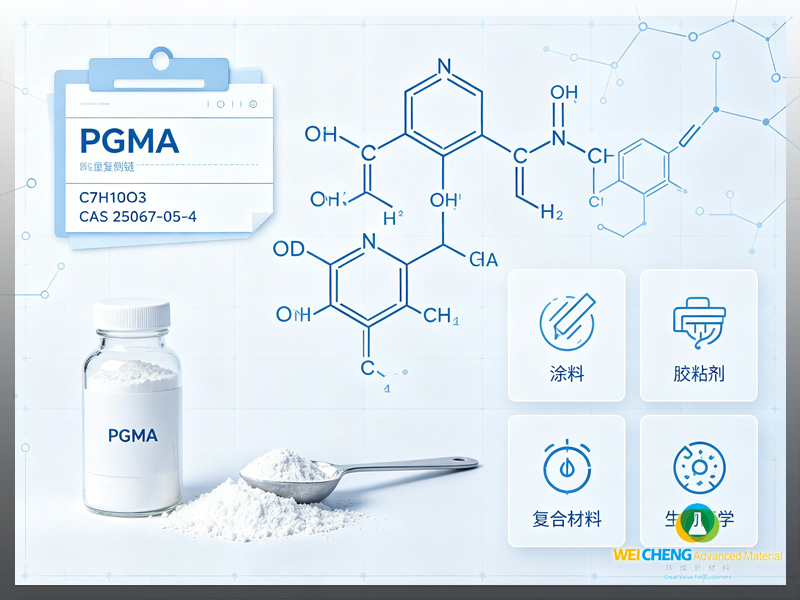
PGMA is a polar amorphous acrylic polymer with pendant epoxy groups. Its solubility depends on solvent polarity and hydrogen-bonding capacity. It dissolves in strong polar aprotic solvents, partially swells in weak polar solvents, and is completely insoluble in nonpolar & protic low-polar solvents.
2. Fully Soluble Solvents (Room Temperature)
These solvents can completely dissolve PGMA to form clear homogeneous solutions, commonly used for coating formulation, film casting, GPC testing:
Ketones: Acetone, methyl ethyl ketone (MEK), cyclohexanone
Ethers: Tetrahydrofuran (THF, standard solvent for molecular weight test), 1,4-dioxane
Halogenated solvents: Dichloromethane, chloroform
Polar amides: N,N-Dimethylformamide (DMF), dimethylacetamide (DMAc)
Esters: Ethyl acetate, butyl acetate (slightly slower dissolution, mild heating accelerates dissolving)
3. Partially Swellable / Slow Dissolving Solvents
PGMA only swells but cannot fully dissolve into transparent solution; long-time stirring will form turbid paste:
Low-boiling alcohols: Isopropanol, n-butanol
Aromatics: Toluene, xylene
Dimethyl sulfoxide (DMSO): Slow dissolution, needs heating above 60°C
4. Insoluble Solvents (No swelling, no dissolution)
No interaction with PGMA powder, solid powder precipitates directly without volume expansion:
Water & aqueous solutions: Deionized water, acid/alkaline water solutions
Aliphatic hydrocarbons: n-hexane, heptane, petroleum ether, mineral oil
Low-polar alcohols: Methanol, ethanol
Long-chain alkanes & paraffin solvents
5. Key Influencing Factors
Molecular weight effectMw 40,000–80,000 PGMA has moderate molecular chain entanglement. Compared with low-MW PGMA (<20,000), it dissolves slower and requires longer stirring or mild heating; high-MW grade needs higher solvent dosage.
TemperatureIncreasing temperature (40–60°C) greatly shortens dissolution time; temperature above 100°C is forbidden—epoxy groups tend to self-crosslink and cause gelation.
Concentration limitNormal usable formulation concentration: 10–30 wt%. Concentrations over 35 wt% produce high-viscosity gel-like liquid.
Crosslinking impactAfter epoxy crosslinking with amine/carboxyl curing agents, PGMA turns into crosslinked thermoset resin and loses solubility in all organic solvents, only swelling may occur.
6. Practical Application Tips
GPC molecular weight detection: Use pure THF as mobile phase, standard solvent for PGMA testing.
Coating raw material preparation: Mix acetone/ethyl acetate as composite solvent to adjust construction viscosity.
Precipitation purification: Add ethanol or hexane into PGMA THF solution to precipitate pure PGMA powder for purification.
Storage reminder: Avoid long-term mixing with alcohol diluents, which will cause incomplete dissolution and turbid coating liquid.

 Home
Home Products
 News
News Call
Call