


Poly(glycidyl methacrylate) (PGMA)
- 2026-07-15
- 128
- Weicheng Advanced Material (Shandong) Co., Ltd.
AI-assisted content. please verify.
Poly(glycidyl methacrylate) (PGMA)
Molecular Weight: Mw = 40,000 ~ 80,000Complete Physical & Thermal Property Data
1. Basic Information
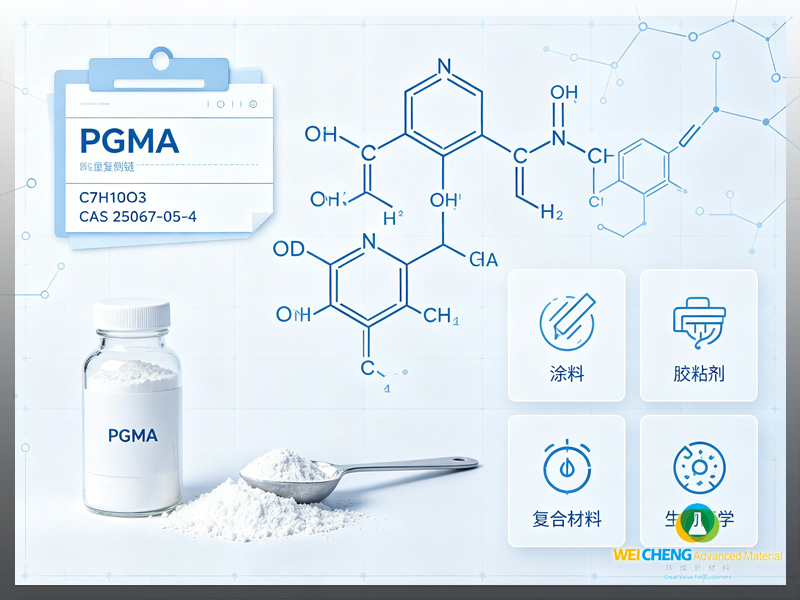
Full Name: Poly(glycidyl methacrylate), PGMA
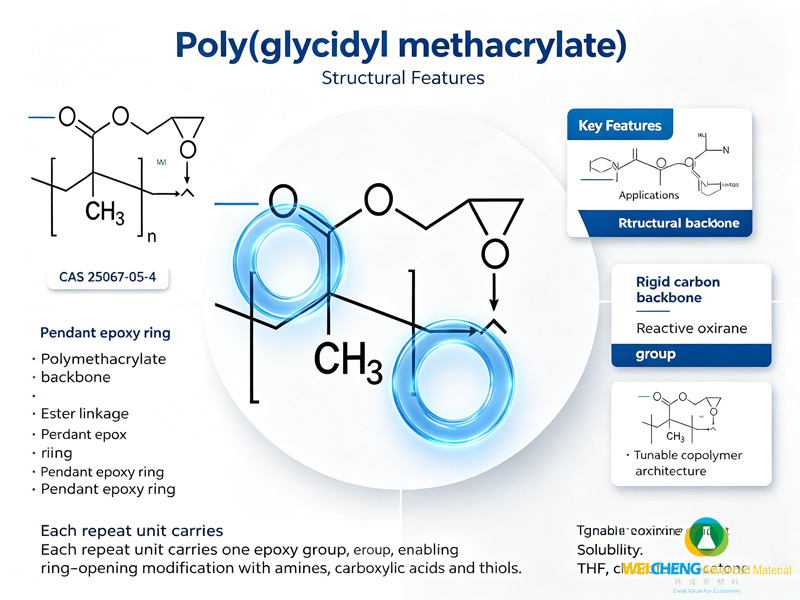
Repeating Unit Formula: C₇H₁₀O₃
Monomer Molecular Weight: 142.15 g/mol
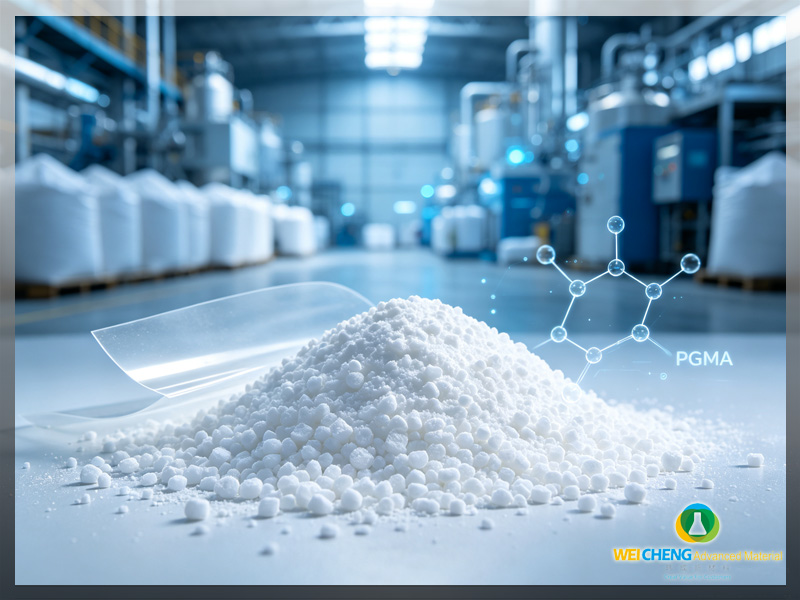
Appearance: White ultrafine free-flowing powder
Molecular Weight Range: Mw 40,000 – 80,000
Polydispersity Index (PDI): 1.6 ~ 2.4 (conventional free radical polymerization); 1.2 ~ 1.5 (controlled radical polymerization)
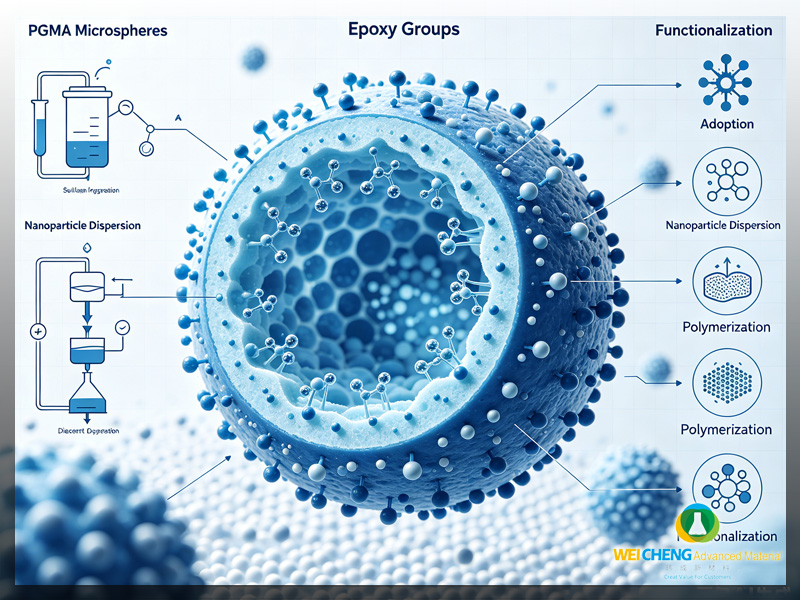
Structure Feature: Fully amorphous linear homopolymer with pendant epoxy groups
2. Thermal Properties
Glass Transition Temperature (Tg): 83 ~ 94 °C
Mw 40,000: 82 ~ 86 °C
Mw 60,000: 86 ~ 91 °C
Mw 80,000: 90 ~ 95 °C
Standard marked value: 85 ± 5 °C (tested by DSC, 10 °C/min heating rate, ASTM D3418)
Melting Point (Tm): No melting peak detectedPGMA is completely amorphous; no crystalline structure forms, so no melting point exists. Only viscous flow occurs above Tg.
Viscous Flow Processing Window: 120 ~ 210 °C
Thermal Decomposition Temperature (Td, 5% weight loss under N₂): ≥ 250 °C
Slow degradation above 240 °C
Severe thermal decomposition & self-crosslinking of epoxy groups above 280 °C
Coefficient of Linear Thermal Expansion: 7.2 × 10⁻⁵ ~ 8.5 × 10⁻⁵ K⁻¹
3. Physical & Mechanical Properties
Density (25 °C, compacted powder): 1.22 ~ 1.26 g/cm³
Refractive Index (nᴰ²⁰): 1.520 ~ 1.535
Tensile Strength (cast film): 62 ~ 70 MPa
Young’s Modulus: 3.2 ~ 3.6 GPa
Elongation at Break: 2.5 ~ 5.0 % (rigid & brittle polymer)
Rockwell Hardness: M82 ~ M88
4. Rheological Properties
Mark-Houwink Equation (THF, 30 °C): [η] = 1.12×10⁻⁴ × Mw⁰·⁷¹
Melt Viscosity at 200 °C
Mw 40,000: ~3500 Pa·s
Mw 80,000: ~18000 Pa·s
Flow Characteristic: Moderate melt fluidity; higher molecular weight leads to significantly increased viscosity
5. Solubility
Soluble: Tetrahydrofuran (THF), acetone, DMF, dichloromethane and other polar organic solvents
Insoluble: Water, ethanol, aliphatic hydrocarbons, mineral oil
6. Chemical & Epoxy Functional Properties
Theoretical Epoxy Equivalent Weight: 142 g/eq
Industrial Epoxy Value: 0.68 ~ 0.72 eq/100 g
Reactive Groups: Pendant oxirane (epoxy) rings
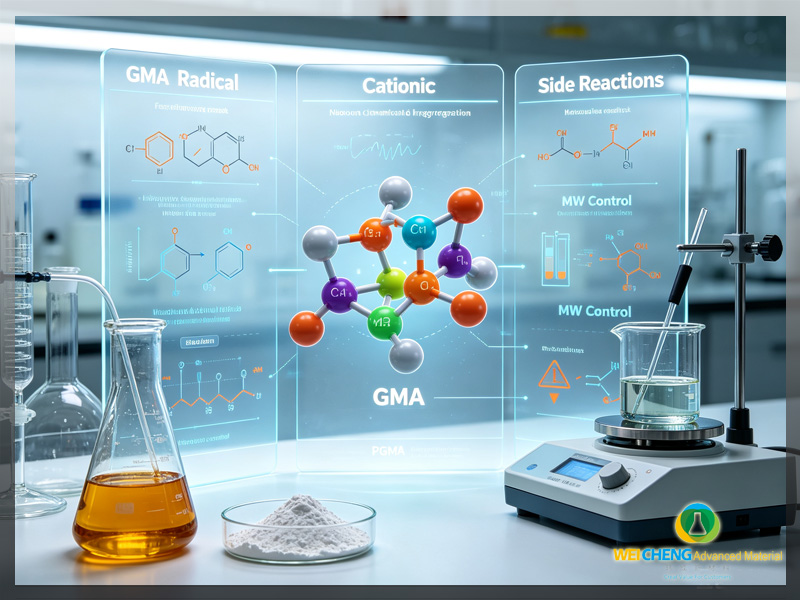
Crosslinking Reactions: Reacts with primary amines, secondary amines, thiols, carboxylic acids under mild heating or room temperature
Chemical Resistance: Resistant to weak acid, weak alkali and mineral oil; swelling occurs in strong polar aprotic solvents
7. Product Feature Summary (Marketing Version)
Poly(glycidyl methacrylate) with Mw 40,000–80,000 balances good film-forming performance, moderate melt fluidity and high epoxy reactivity. It avoids low-molecular-weight migration while retaining sufficient reactive sites for crosslinking. Suitable for coating additives, adhesive modifiers, powder coating curing agents and polymer compatibilizers.
Standard Short Description for Catalog
PGMA, white amorphous powder, Mw 40,000–80,000, Tg 85±5°C, no melting point, soluble in ketones and ethers, carrying high-activity epoxy side chains for crosslink modification. Stable below 220 °C for thermal processing.

 Home
Home Products
 News
News Call
Call